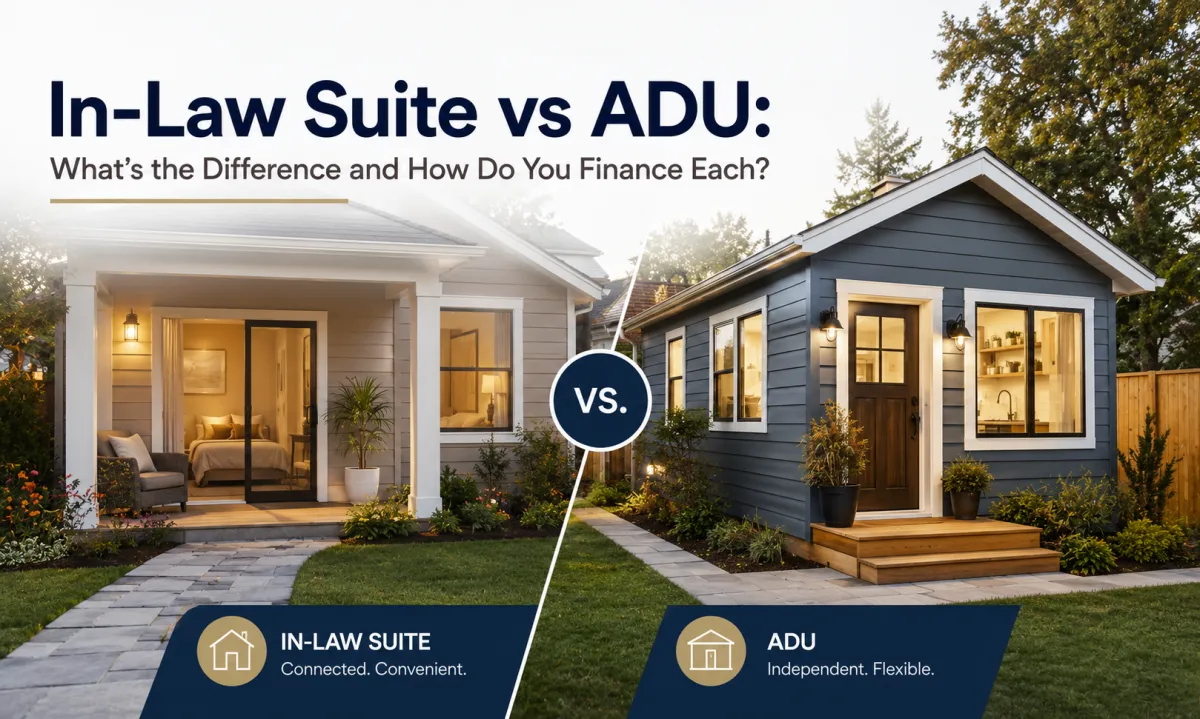
In-Law Suite vs ADU: Florida Financing Guide for Homeowners
As more Florida families look for flexible living arrangements, many homeowners are asking whether an in-law suite or an accessory dwelling unit may work better for their needs.
Some families want space for aging parents.
Others want room for adult children, caregivers, guests, or long-term multigenerational living.
In many cases, homeowners are also exploring whether these spaces may help improve property value, create additional privacy, or support future housing flexibility.
Although the terms “in-law suite” and “ADU” are often used interchangeably, they are not always the same thing from a financing, zoning, or appraisal standpoint.
Understanding the differences can help Florida homeowners make more informed decisions before buying, building, renovating, or refinancing a property.
What Is an In-Law Suite?
An in-law suite is generally a secondary living area located within or attached to the main home.
These spaces are often designed for family members, especially aging parents or adult children.
An in-law suite may include:
A bedroom and bathroom.
A small kitchenette.
A private entrance.
A converted garage area.
A first-floor guest suite.
An attached living space connected to the primary home.
Some in-law suites function more like expanded guest quarters, while others operate almost like separate apartments.
However, not every in-law suite legally qualifies as a separate dwelling unit.
That distinction matters when financing or appraising the property.
What Is an ADU?
An accessory dwelling unit, commonly called an ADU, is a separate secondary housing unit located on the same property as a primary residence.
ADUs are typically more independent than standard in-law suites.
An ADU may include:
Its own kitchen.
A separate bathroom.
Sleeping space.
A separate entrance.
Independent utility features in some situations.
Detached or attached construction.
Examples may include:
Garage apartments.
Detached backyard cottages.
Basement apartments.
Tiny homes on the same lot.
Detached guest houses.
Florida zoning rules for ADUs vary by county and municipality.
Some areas are more ADU-friendly than others.
Homeowners should verify local zoning, permitting, and occupancy rules before purchasing or building a property intended for multigenerational use.
Families considering an ADU or in-law suite may also benefit from reviewing housing and financial planning resources that discuss budgeting, shared living arrangements, and long-term household planning.
The Main Difference Between an In-Law Suite and an ADU
The biggest difference is usually whether the space legally qualifies as a separate dwelling unit.
An in-law suite is often considered part of the primary residence.
An ADU is generally recognized as a separate secondary housing unit on the property.
This difference may affect:
Financing eligibility.
Property classification.
Appraisal treatment.
Rental income considerations.
Insurance requirements.
Permitting requirements.
Zoning compliance.
Property taxes.
Not every in-law suite qualifies as an ADU.
Not every ADU qualifies for rental income consideration.
And not every property with separate living space automatically meets lender guidelines.
Why More Florida Families Are Considering ADUs and In-Law Suites
Florida families are increasingly exploring flexible housing arrangements because of:
Rising home prices.
Higher insurance costs.
Long-term caregiving needs.
Multigenerational living trends.
Retirement planning.
Adult children moving back home.
The need for privacy within shared housing.
Some households are also looking for properties that may offer future flexibility if family needs change later.
For example:
A space initially used for aging parents may later become a guest suite, office, or rental space depending on local rules and loan program requirements.
How Financing Works for In-Law Suites
Homes with in-law suites are often financed using standard mortgage programs.
Possible financing options may include:
Conventional loans.
FHA loans.
VA loans for eligible borrowers.
USDA loans in eligible rural areas.
Cash-out refinances.
Renovation loans.
Home equity loans or HELOCs.
The financing process depends on several factors, including:
Whether the suite is permitted.
How the appraiser classifies the property.
Whether the living area is considered fully independent.
The property type.
Occupancy.
Local zoning.
Lender guidelines.
In many situations, an attached in-law suite may still allow the home to qualify as a standard single-family residence.
How Financing Works for ADUs
ADU financing can become more complex because lenders often review the property differently.
Lenders may evaluate:
Whether the ADU is legal and permitted.
Whether local zoning allows the structure.
Whether the ADU affects property classification.
The appraiser’s opinion of value.
Whether rental income may be considered.
The number of units on the property.
The intended occupancy.
Some conventional loan programs may allow eligible ADU rental income under certain circumstances.
However, borrowers should not assume rental income automatically qualifies.
Documentation and underwriting requirements matter.
Can You Use Rental Income From an ADU?
In some situations, yes.
Certain conventional programs may allow limited rental income consideration from an existing ADU on an eligible owner-occupied property.
However, eligibility depends on:
Loan program guidelines.
Property type.
Appraisal documentation.
Lease documentation if applicable.
Occupancy requirements.
Lender overlays.
Borrower qualification.
Borrowers should review current requirements carefully before relying on projected rental income during qualification.
FHA and VA Loans for Properties With ADUs
FHA and VA financing may also work for some properties with ADUs depending on the structure and occupancy.
These programs still require the home to meet appraisal, occupancy, and underwriting standards.
For example:
An eligible borrower may purchase a home with an existing ADU while occupying the property as a primary residence.
However, program requirements vary depending on the loan structure and property setup.
Not every ADU property automatically qualifies.
Building an ADU vs Buying a Home With One
Some homeowners buy a property that already includes an ADU.
Others plan to build one later.
Possible financing options for building may include:
Construction loans.
Renovation loans.
Cash-out refinancing.
Home equity financing.
Construction-to-permanent financing.
Before building, homeowners should review:
Local zoning rules.
Permit requirements.
Utility access.
HOA restrictions.
Setback rules.
Contractor licensing.
Insurance implications.
Future property tax changes.
An ADU project may involve more planning and approval steps than many homeowners initially expect.
Florida HOA and Zoning Considerations
HOA rules and local zoning laws can significantly affect whether an ADU or expanded in-law suite is allowed.
Some Florida communities restrict:
Detached guest houses.
Garage conversions.
Separate entrances.
Additional kitchens.
Parking arrangements.
Long-term occupancy changes.
Exterior additions.
Before purchasing a property or beginning construction, homeowners should verify local rules carefully.
Insurance and Property Tax Considerations
Adding an ADU or expanding an in-law suite may affect homeowners insurance and property taxes.
Insurance carriers may review:
Replacement cost.
Detached structures.
Rental exposure.
Liability concerns.
Construction quality.
Wind mitigation features.
Property taxes may also change if the property is reassessed after improvements are completed.
Homeowners should review these potential costs before beginning construction or renovations.
Accessibility and Long-Term Planning
Many Florida homeowners build in-law suites or ADUs for aging parents.
Long-term accessibility planning can become important.
Features that may help include:
Single-story layouts.
Walk-in showers.
Low-step entrances.
Wider doorways.
First-floor bedrooms.
Accessible bathrooms.
Homes designed for multigenerational living may work better long term when future mobility needs are considered early.
Common Mistakes Homeowners Should Avoid
Some homeowners assume every separate living space automatically qualifies as an ADU.
Others assume projected rental income will automatically count toward mortgage qualification.
Common mistakes may include:
Failing to verify permits.
Ignoring zoning restrictions.
Not reviewing HOA rules.
Overestimating rental income eligibility.
Beginning renovations before confirming financing options.
Overlooking insurance impacts.
Not reviewing property classification.
Misunderstanding occupancy rules.
Careful planning early may help avoid delays and unexpected costs later.
A Careful Review Can Help Homeowners Compare Their Options
In-law suites and ADUs can both support multigenerational living, flexible housing arrangements, and long-term family planning.
However, the financing, zoning, appraisal, and qualification considerations are not always the same.
The right approach depends on the property, the household structure, local regulations, financing goals, and future plans for the home.
Before purchasing, building, or refinancing a property with additional living space, homeowners may benefit from reviewing zoning, permits, insurance costs, financing options, and occupancy requirements carefully.
A licensed Florida mortgage professional can help review possible financing structures, explain qualification considerations, and help homeowners explore options that may fit their situation.
For more information about family-focused mortgage planning, you can also visit our multigenerational home financing page. This page can help Florida families review possible loan structures, co-borrower considerations, and financing paths that may be available depending on qualification.
You can also explore additional Florida mortgage education and homeowner financing topics through Smart N Loans mortgage education resources.
𝗞𝗲𝗹𝗹𝘆 𝗡𝗮𝗱𝗲𝗮𝘂 𝗡𝗠𝗟𝗦# 𝟭𝟬𝟮𝟳𝟲𝟭𝟴 | 𝗥𝗮𝘆 𝗡𝗮𝗱𝗲𝗮𝘂 𝗡𝗠𝗟𝗦# 𝟭𝟬𝟮𝟳𝟲𝟭𝟳
Loan Officers | Licensed in Florida
Equity Smart Home Loans
Visit Smart-N-Loans.com
Equity Smart Home Loans NMLS# 856170 | DRE# 01906808
1499 Huntington Dr, Suite 500, South Pasadena, CA 91030
Equal Housing Lender
Rates, fees, and programs are subject to change without notice. This is not a guarantee or a commitment to lend. Some products may not be available in all states. Not all applicants qualify for financing; subject to review of credit and collateral.