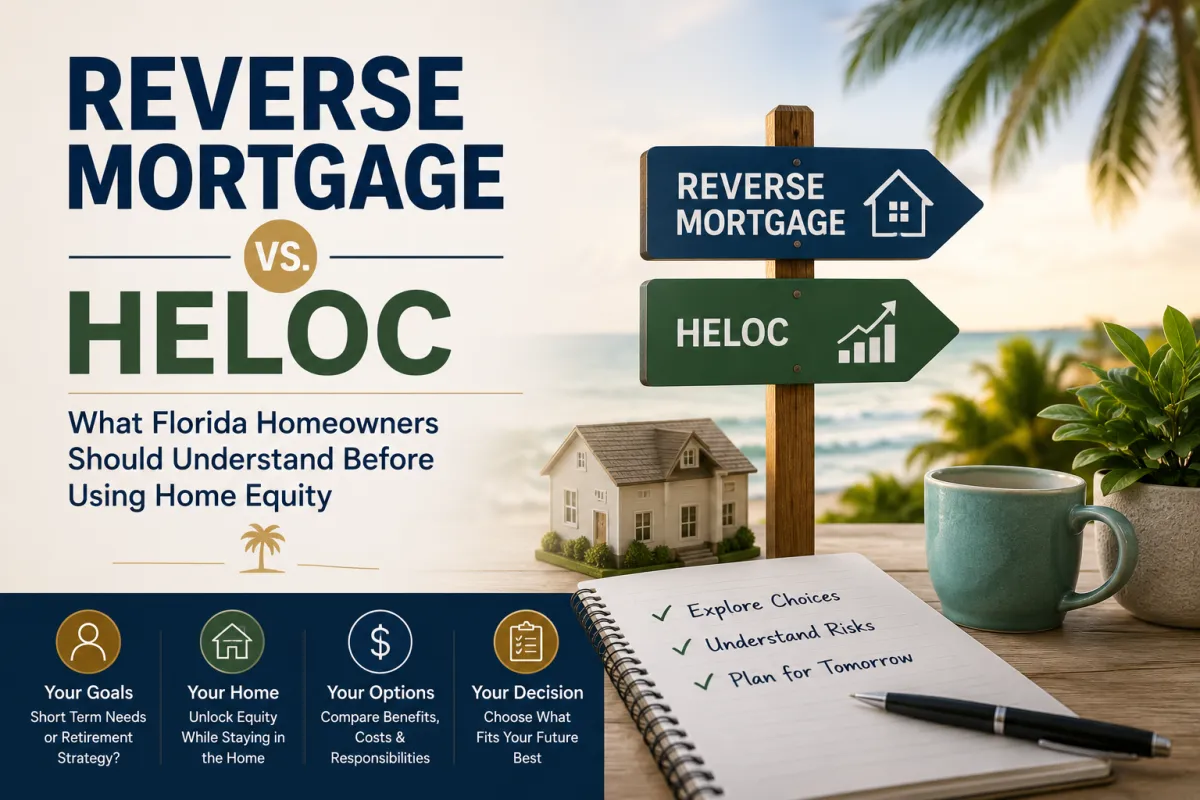
Reverse Mortgage Versus HELOC for Florida Homeowners
For many Florida homeowners approaching retirement, home equity may represent one of the largest financial resources they have built over decades of ownership.
As retirement planning becomes more complex and monthly expenses continue rising, many homeowners begin asking an important question:
Should I use a reverse mortgage or a HELOC to access my home equity?
Both options allow homeowners to borrow against available equity, but they work very differently.
Some homeowners prioritize:
lower monthly obligations
retirement cash flow flexibility
aging in place planning
Others may prefer:
shorter term borrowing
traditional repayment structures
preserving long term equity differently
Understanding the differences between a reverse mortgage and a home equity line of credit commonly called a HELOC is important because the right option depends heavily on:
retirement goals
income stability
future housing plans
long term financial strategy
This guide explains how reverse mortgages and HELOCs work, the major differences between them, and what Florida homeowners should consider before using home equity in retirement.
Why More Florida Homeowners Are Exploring Home Equity Options
Florida homeowners today are facing a very different retirement environment than previous generations.
Many retirees are managing:
higher property insurance costs
inflation pressure
rising healthcare expenses
market volatility
longer retirement timelines
At the same time, many older homeowners have substantial home equity due to years of appreciation across Florida housing markets.
Because of this, homeowners increasingly explore ways to:
improve retirement cash flow
reduce monthly obligations
create emergency reserves
supplement retirement income
preserve investment accounts during market downturns
Two of the most common options are:
reverse mortgages
and
HELOCs
However, these solutions are designed for very different financial situations.
What Is a Reverse Mortgage?
A reverse mortgage is a loan available to eligible homeowners age 62 and older that may allow them to convert part of their home equity into accessible funds while continuing living in the home.
The most common reverse mortgage program is the:
Home Equity Conversion Mortgage or HECM
HECM loans are federally insured by the FHA.
Unlike traditional loans, reverse mortgages generally do not require monthly principal and interest payments as long as borrowers continue:
occupying the home
paying property taxes
maintaining homeowners insurance
maintaining the property
Funds may be received through:
lump sum proceeds
monthly installments
line of credit access
combination payment structures
Homeowners can review official HECM information through the U.S. Department of Housing and Urban Development website.
What Is a HELOC?
A HELOC or Home Equity Line of Credit is a revolving line of credit secured by home equity.
A HELOC works more similarly to a credit card:
homeowners may borrow funds as needed
interest is charged on amounts borrowed
borrowers usually make monthly payments
available credit may fluctuate
HELOCs are commonly used for:
renovations
short term expenses
debt consolidation
emergency reserves
temporary liquidity needs
Unlike reverse mortgages, HELOC qualification usually depends heavily on:
income
debt to income ratios
employment
credit profile
HELOC lenders also commonly require monthly repayment obligations immediately after borrowing begins.
The Biggest Difference Between Reverse Mortgages and HELOCs
The single largest difference is:
monthly payment structure
A HELOC usually requires:
monthly payments
ongoing income qualification
debt repayment obligations
A reverse mortgage generally does not require monthly principal and interest payments while the borrower continues meeting loan obligations.
For retirees living on fixed income, this distinction may significantly affect:
monthly budgeting
retirement cash flow
financial flexibility
However, avoiding monthly mortgage payments also means reverse mortgage balances generally increase over time because interest accrues on the outstanding balance.
Why Some Retirees Prefer Reverse Mortgages
For some Florida retirees, monthly cash flow becomes more important than long term equity preservation.
Examples may include homeowners who:
want to eliminate an existing mortgage payment
live primarily on retirement income
want additional financial flexibility
prefer avoiding required monthly loan payments
plan to remain in the home long term
Some homeowners also explore HECM lines of credit as:
emergency reserve strategies
market volatility buffers
retirement liquidity tools
This does not mean reverse mortgages are automatically the best choice. However, retirement planning goals often differ significantly from the goals of younger borrowers using HELOCs for short term financing.
Why Some Homeowners Prefer HELOCs
A HELOC may appeal more to homeowners who:
still have stable income
want short term borrowing flexibility
plan to repay borrowed funds aggressively
prioritize preserving long term equity differently
expect to move or sell the property within a shorter timeframe
Because HELOC balances may be repaid faster, some homeowners feel more comfortable with:
traditional repayment structures
lower overall borrowing periods
more direct control over debt reduction
However, HELOC payments may increase if:
interest rates rise
repayment periods change
borrowing balances increase
This can create budgeting uncertainty especially during retirement.
Interest Rate Differences
Both HELOCs and reverse mortgages may involve adjustable interest rate structures depending on the loan product selected.
However, borrowers should understand:
HELOC payments may rise when rates increase
reverse mortgage balances may grow faster when rates rise
Neither option is risk free.
Homeowners benefit from reviewing:
long term costs
repayment expectations
equity impact
future financial goals
before making decisions involving home equity.
Reverse Mortgage Versus HELOC Qualification Requirements
Qualification standards also differ substantially.
Reverse Mortgage Qualification
HECM reverse mortgages generally focus on:
borrower age
home equity
property eligibility
ability to maintain taxes and insurance
Traditional income requirements may be less restrictive than conventional home equity lending.
HELOC Qualification
HELOC qualification commonly emphasizes:
income verification
debt to income ratios
credit profile
employment history
repayment ability
This may create challenges for some retirees with:
limited taxable income
fixed retirement income
nontraditional income structures
Which Option Preserves More Equity?
This depends heavily on:
borrowing behavior
repayment strategy
loan structure
interest rates
length of time in the home
A HELOC may preserve more equity if:
balances are repaid quickly
borrowing remains limited
homeowners aggressively reduce debt
A reverse mortgage balance generally grows over time because payments are deferred.
However, some retirees prioritize:
improved monthly cash flow
retirement flexibility
housing stability
over maximizing long term equity preservation.
The right answer depends entirely on individual financial priorities.
Emotional Concerns Often Matter Too
Many retirement borrowing decisions are emotional not just financial.
Homeowners commonly worry about:
running out of retirement savings
losing housing stability
becoming financially dependent on family
healthcare expenses
preserving inheritance
maintaining independence
Because of this, reverse mortgage versus HELOC decisions are rarely simple math equations.
The best decision often involves:
financial goals
retirement lifestyle preferences
stress reduction priorities
long term housing expectations
Understanding these emotional concerns matters just as much as understanding loan mechanics.
Questions Florida Homeowners Commonly Ask
Is a reverse mortgage safer than a HELOC?
Neither product is universally safer. Suitability depends on financial goals, repayment ability, and retirement strategy.
Can a HELOC payment increase?
Yes. Many HELOCs have adjustable rates that may cause payments to rise over time.
Can a reverse mortgage line of credit grow?
Unused available credit on certain HECM lines of credit may grow over time under program terms.
Which option is better for retirement cash flow?
Some retirees prefer reverse mortgages because they may reduce required monthly mortgage obligations.
Which option costs more long term?
Long term costs vary depending on:
interest rates
repayment timeline
borrowing amount
loan structure
time in the property
Final Thoughts
Both reverse mortgages and HELOCs allow homeowners to access home equity, but they are designed for very different financial situations.
For some Florida homeowners, a HELOC may provide useful short term borrowing flexibility.
For others, a reverse mortgage may better align with retirement cash flow goals and long term housing plans.
The important step is understanding:
how each product works
repayment expectations
long term costs
borrower responsibilities
retirement implications
before making a decision involving home equity.
Homeowners who fully understand both options are often better positioned to choose the strategy that best fits their financial goals and retirement plans.
You can also read our main guide:
Reverse Mortgages Explained A Complete Florida Guide for Homeowners Age 62 Plus
for a broader overview of reverse mortgage eligibility, repayment rules, myths, and retirement planning considerations.
If you would like to better understand whether a reverse mortgage or HELOC may fit your financial goals, reviewing available options with a licensed mortgage professional may help you evaluate possible solutions based on your retirement plans, equity position, and long term objectives.
𝗞𝗲𝗹𝗹𝘆 𝗡𝗮𝗱𝗲𝗮𝘂 𝗡𝗠𝗟𝗦# 𝟭𝟬𝟮𝟳𝟲𝟭𝟴 | 𝗥𝗮𝘆 𝗡𝗮𝗱𝗲𝗮𝘂 𝗡𝗠𝗟𝗦# 𝟭𝟬𝟮𝟳𝟲𝟭𝟳
Loan Officers | Licensed in Florida
Equity Smart Home Loans
Visit Smart-N-Loans.com
Equity Smart Home Loans NMLS# 856170 | DRE# 01906808
1499 Huntington Dr, Suite 500, South Pasadena, CA 91030
Equal Housing Lender
Rates, fees, and programs are subject to change without notice. This is not a guarantee or a commitment to lend. Some products may not be available in all states. Not all applicants qualify for financing; subject to review of credit and collateral.